The lab has a new research project: AI-assisted video. A short drama series, narrated shorts, the whole pipeline from script to cut. I knew how to automate things. I didn't know how to make a face keep still across ten shots, or why a lip-sync falls apart on the first word.
The fastest way in was other people's experience, so I joined four courses on AI video and growing a channel, three of them paid. The biggest had 132 open lessons, most of them videos. Watching all of it myself would have taken weeks, and most of it was written for someone else's work: photoreal influencers, short social ads, long-form explainers.
A course is a list of claims. Some will hold for my work and some won't, and the only way to find out is to try them.
So agents attended the courses for me, in three days. Every lesson became a row in a claims ledger, and every row gets a cheap test on our own footage.
Attending
The agents attend with the video-watch tool from an earlier post: a video becomes labelled frames and a timestamped transcript, which Claude can read. Not every lesson needed the frames. Where the platform had a caption track, the agent read that instead, and some lessons were text all along.
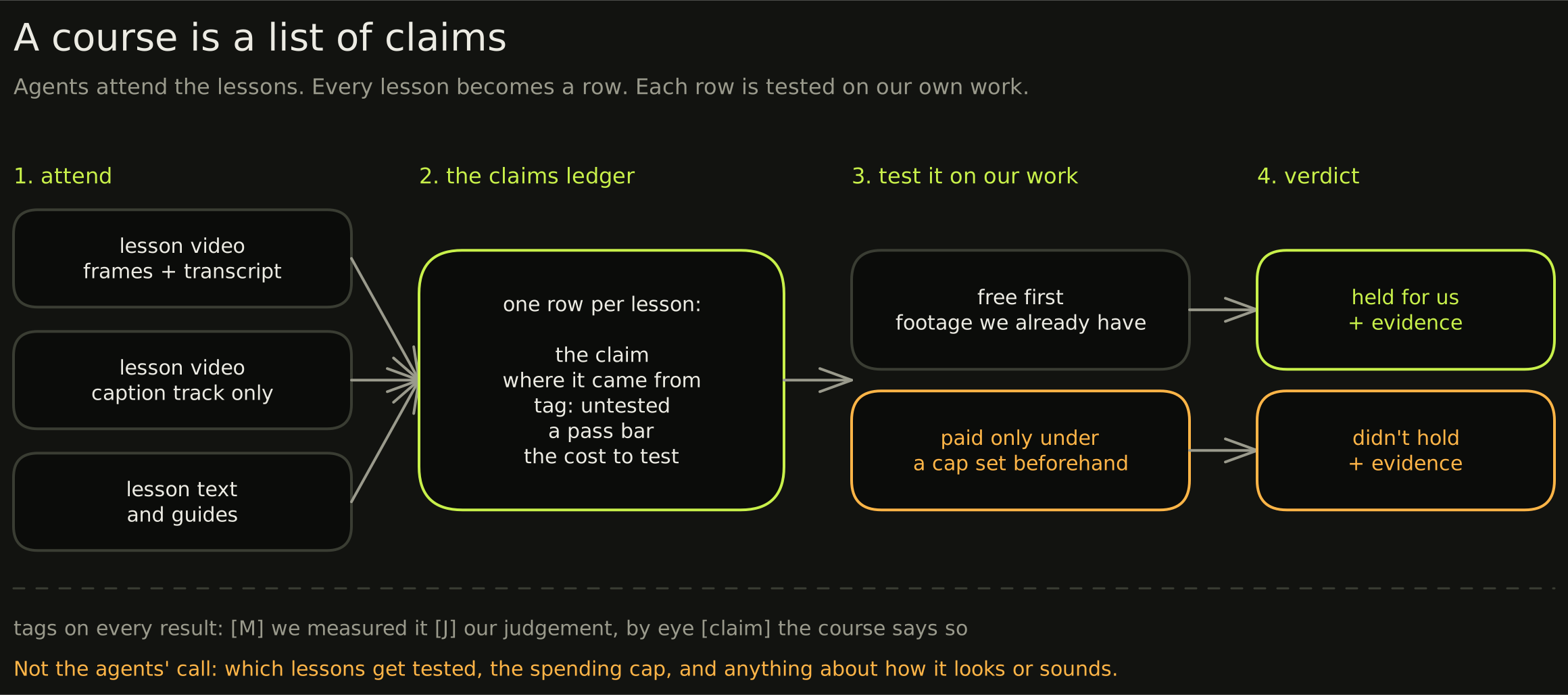
On one course, 76 of the 80 videos in its main lesson set went through video-watch with frames. On the others it was mostly caption tracks and lesson text. The agents only read: anything that would have posted to a course's community came back to me as a draft, and they bought nothing.
The ledger
Each lesson becomes a row with the same fields. Here is one, condensed from the repo:
Claim     Fake a three-camera shoot: punch in on one clip for wide, medium, close
Source    one course's guide pages, paraphrased                 [claim]
Test      crop one approved 720p take to 70% and 45%, scale to 1080×1920
Pass bar  sharp at phone size, by eye
Cost      US$0
Result    pass at phone size [J]; at full size the 45% crop is visibly soft
Every row starts as untested. The pass bar is written before the test runs, so a result can't drift to fit what came back. The tags say how much a result is worth: [M] we measured it, [J] it's our judgement by eye, [claim] the course says so and nobody has checked.
The order is free first. Plenty of claims can be tested on footage we already have, or by a script that reads our own prompts. The ones that need a paid generation ride on shots we need anyway where possible, and only run under a spending cap set before they start.
Three results
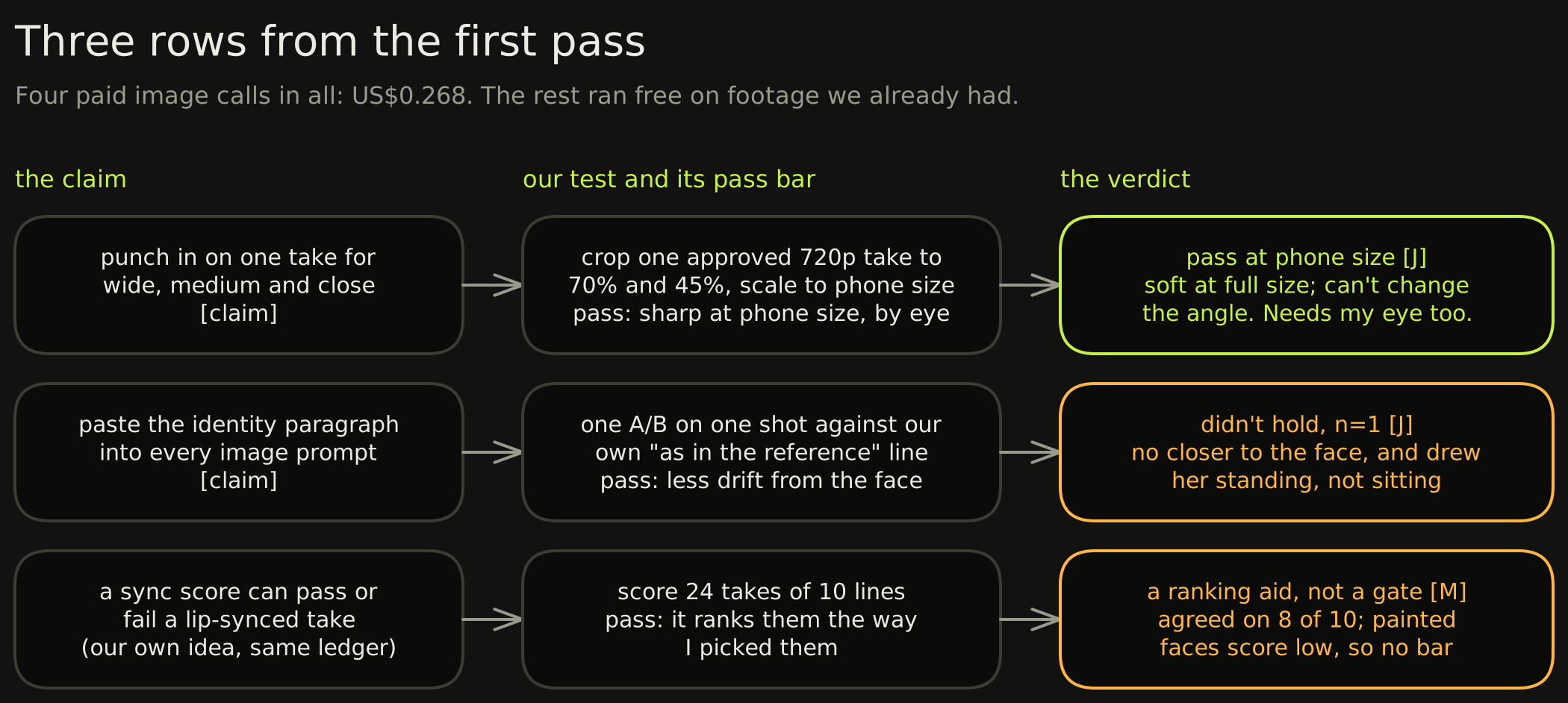
The punch-in held, with limits. At phone size, all three crops of one 720p take read clean, because the painted style hides the upscale. At full size the close crop, a 3.3× blow-up, is soft. It can't change the angle or the eyeline, and a centre crop cut a character out of the frame, so the crop window has to be planned per shot. The course said it only works from a 1080p source; for our look, 720p was enough at phone size, by the agent's eye.
The identity paragraph didn't hold, once. One guide says to paste a character's description word for word into every image prompt. Another lesson from the same course says never to re-describe a face that has a reference attached. One A/B settled it for us, for now: the face came out no closer to the reference, and the description's body words drew her standing when the shot had her sitting on a bed. That's one sample, so it's a lean, not proof. We keep our own line.
The sync score is a ranking aid, not a gate. This one wasn't from a course. It was our own untested idea, and the ledger takes those too. A lip-sync scorer rated 24 takes of 10 lines. It agreed with the take I'd picked on 8 of the 10, with one tie and one clear disagreement. But painted faces score low: 9 of my 10 picks scored under 5, where the tool suggests about 6 or more for real faces. So it can rank takes of one shot, and flag a big gap, but it can't pass or fail one.
The whole first pass made four paid image calls, for US$0.268. Everything else ran free, on footage we already had and a GPU at home.
What the agents don't decide
I decided that every lesson gets tested. The agents write the rows, run the free tests and draft the paid ones. Three things stay with people:
- What gets spent. A paid test runs only under a cap set before it starts, and only one paid spender works at a time.
- How it looks and sounds. Where a test is about looks or sound, I judge the result myself. One course recommended a lip-sync service; on the same shot, I judged the one we already use better, so it didn't hold for us. The punch-in above passed by an agent's eye, and it isn't a lesson until it passes mine.
- What doesn't run. Three paid rows were held back. One would have generated a production shot as "research" and gone round the gate that shot waits behind. The other two needed code changes first. A ledger row isn't a reason to skip the process.
Useful for research, not for learning
This is a research method. It works when the question is "which of these claims hold for my work?", and you'd rather have evidence than a summary.
Don't use it for a course you ought to learn yourself. If it's a skill you'll need, a certification, or anything you'll be expected to know, an agent attending it for you teaches you nothing. You'd have a tidy ledger and no new ability. I can talk about what held for our videos because I looked at every result that mattered; I still couldn't teach the course.
Compared with NotebookLM
The obvious free alternative is Google's NotebookLM, renamed Gemini Notebook in July 2026. I didn't run it side by side; this is from Google's own help pages.
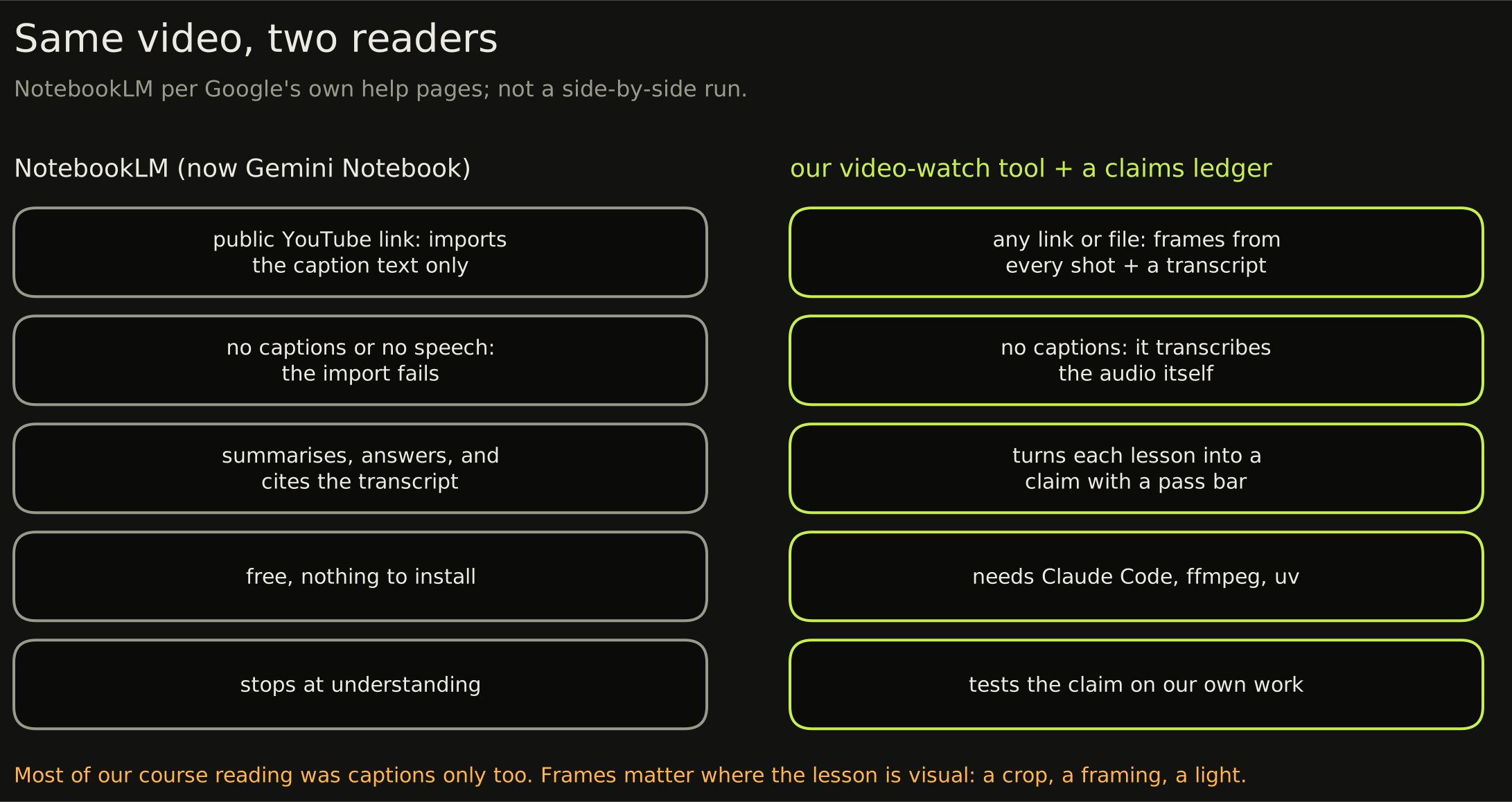
Given a YouTube link, NotebookLM imports the video's text transcript and nothing else. It needs a public video with captions, and a video with no captions or no speech won't import. An uploaded video file is transcribed as audio. What it does well: it's free, needs no setup, and its answers cite the transcript, so you can check where a claim came from.
To be fair to it, most of our own course reading was captions only too. Frames earned their place on lessons where the visuals carry the lesson: a crop, a framing, a lighting setup, a before and after. For a talking-head lesson, a transcript is most of it.
The real gap is the step after. NotebookLM summarises and answers questions about what a course says. It doesn't test anything on your work. You could run the same ledger with NotebookLM as the reader, and the tests would be the same.
Where it falls short
- Some lessons never arrived. Three of those 80 videos failed in the tool, twice each. They're listed by name in the notes rather than skipped quietly.
- A transcript has no tone. On one course the agent read caption tracks and never listened to the sound, so nothing from it judges a voice by ear. Claims about delivery go to me.
- One sample is a lean. The paid tests in this pass were single samples. The ledger says n=1 on the row, so it isn't quoted later as a result.
- "Picked" can be fuzzy. The sync-score test compared against the takes in the approved cut, because who chose each alternate was never recorded.
If you try it
- Turn each lesson into one claim with a source, and tag it untested until you've tried it.
- Write the pass bar before the test.
- Test free first, on work you already have. Put a cap on anything paid before it starts.
- Tag every result as measured, judged or claimed, and keep the evidence beside it.
- Keep the judgement of looks, sound and spend with a person.
- Don't use it on anything you're meant to learn.
The video-watch tool is free on GitHub; the earlier post has the install steps.